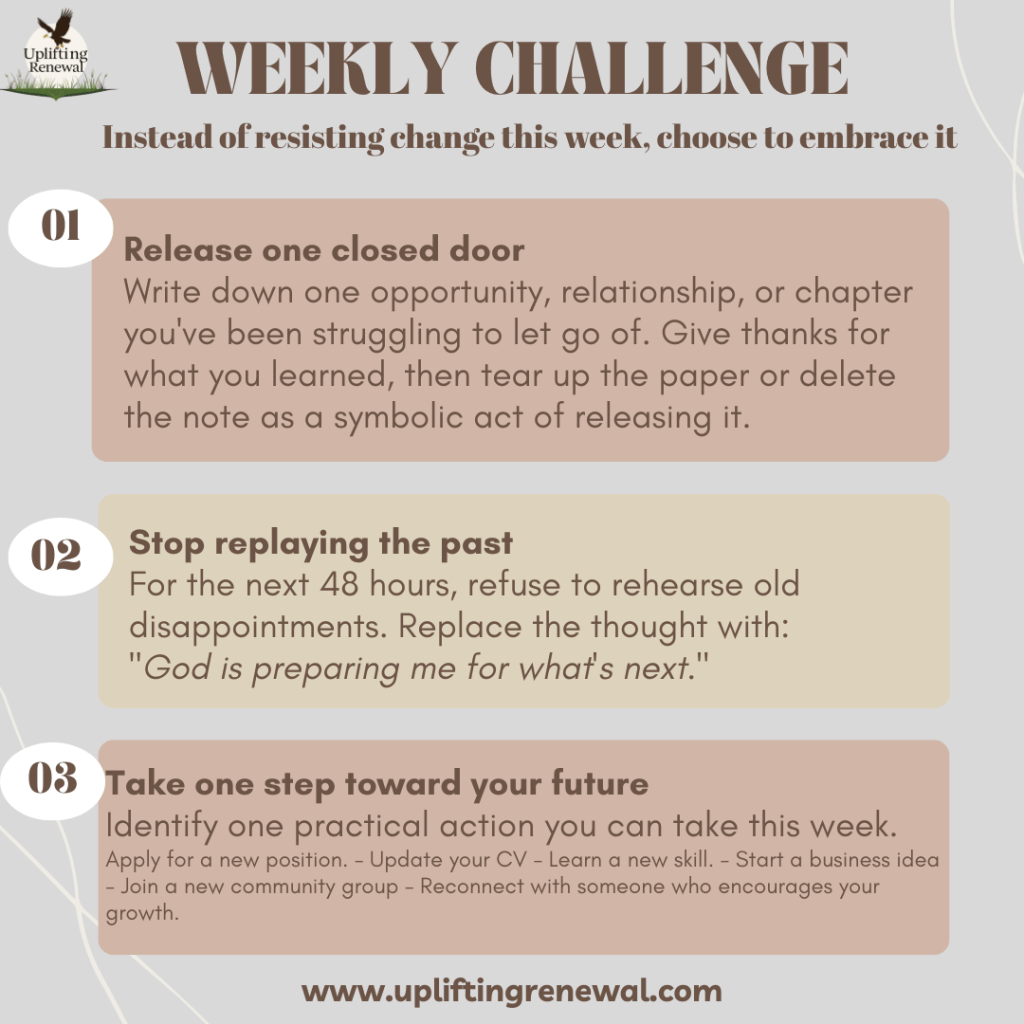
Finding hope in closed doors: Trusting the process
“There are better things ahead than any we leave behind.” — C.S. Lewis
Few experiences are more painful than watching a door close unexpectedly.
One day life feels stable. Your career is progressing, your relationships are flourishing, and your plans seem to be falling into place.
Then everything changes. A redundancy letter arrives. A relationship ends. A business opportunity disappears. A dream you’ve worked towards suddenly slips through your fingers.
In moments like these, it’s natural to ask: “God, where are You?“
But what if the closed door isn’t a sign that God has abandoned you? What if it’s actually evidence that He is leading you somewhere new?
The bible reminds us that “There is a time for everything, and a season for every activity under the heavens.” (Ecclesiastes 3:1).
The God who opens doors is also the God who closes them and He never wastes a season.
Every ending prepares us for a new beginning
When something ends, our first instinct is often to fight it.
- We replay conversations
- We revisit old memories
- We keep trying to force a door open that simply won’t move.
But holding onto a season God has finished only leaves us exhausted.
Sometimes we mistake endings for failure when, in reality, they are preparation.
God is the Alpha and the Omega, the Beginning and the End. He sees what we cannot see and knows where every path leads.
A closed door may not be punishment. It may be protection. Or it may be preparation for something you couldn’t reach without first letting go of where you’ve been.
Faith isn’t only trusting God when He opens doors. Sometimes the greater act of faith is trusting Him when He closes them.
When the manna stops
One of the clearest pictures of this is found in the story of Israel.
For forty years, God faithfully provided manna in the wilderness. Every morning, food appeared exactly when His people needed it.
Then something unexpected happened. The manna stopped.
“The manna ceased… and they ate the produce of the land of Canaan.” – Joshua 5:12
Imagine waking up after forty years and finding nothing on the ground. It probably felt alarming. Had God abandoned them? Had His favour disappeared?
Not at all.
The manna stopped because they had arrived in the Promised Land. God wasn’t removing His provision. He was changing it. If the manna had continued, they may never have learned to live from the abundance of the land God had already given them.
Sometimes God removes what once sustained us because He’s inviting us into something greater.
Practical reflection
Ask yourself:
- Am I grieving something that has simply reached its purpose?
- Is God asking me to grow beyond what once sustained me?
Not every loss is a setback. Sometimes it’s a promotion into a new season.
Some people are seasonal and that’s okay
One of life’s hardest lessons is accepting that not everyone is meant to stay forever.
- A friendship changes
- A mentor moves away
- A colleague resigns
- A relationship ends
Our instinct is often to chase, convince, or hold on tighter.
But sometimes God allows people to leave because their assignment in your life has been completed.
Think of scaffolding around a building. Scaffolding is essential during construction. It provides support while the structure is growing. But once the building is complete, the scaffolding has to come down. If it stayed forever, it would hide the very building it helped create.
Some relationships serve a similar purpose. They help build you for a season. That doesn’t make them failures. It simply means their purpose has been fulfilled.
Divine relationships vs seasonal relationships
Some people are lifelong companions. They remain through victories and disappointments.
Others are seasonal. They arrive to teach, encourage, challenge, or prepare you before moving on.
Learning the difference helps you avoid unnecessary heartache.
Ruth and Orpah
The story of Ruth beautifully illustrates this truth.
After losing their husbands, both Ruth and Orpah stood at a crossroads.
Orpah returned to her old life. Ruth chose to remain with Naomi.
That decision eventually led Ruth to Boaz and into the lineage of King David and ultimately Jesus Christ.
Not everyone who walks away is taking your destiny with them. Sometimes the people who are meant for your future are still ahead of you.
When the brook dries up
Elijah experienced another powerful transition.
God instructed him to stay beside the Brook Cherith, where ravens miraculously brought him food.
Everything was working exactly as God promised. Then the brook dried up. The ravens stopped coming.
“Then the word of the Lord came to him: ‘Go at once to Zarephath…'” (1 Kings 17:7–9)
The dry brook wasn’t a sign that God had forgotten Elijah. It was God’s way of saying, “It’s time to move.“
Had Elijah stubbornly remained beside the dry riverbed, he would have missed the widow of Zarephath and the miracles God had prepared there.
Sometimes what feels like loss is actually divine direction. Not every dry season means you’ve taken the wrong path. Sometimes it’s simply God’s invitation to keep walking.
How do you respond when a door closes?
If you’re walking through an unexpected ending today, here are four practical ways to move forward.
1. Stop searching for God in yesterday’s season
Celebrate what was, but be thankful for the lessons. Honour the memories, but don’t build your future around your past. God is always doing something new.
2. Don’t let disappointment become bitterness
Rejection hurts, loss hurts, even change can hurt. But bitterness keeps you emotionally tied to doors God has already closed.
Guard your heart because not every “no” is personal. Sometimes rejection is simply God’s redirection.
3. Look for the next assignment
Instead of asking: “Why did this happen?”
Try asking, “Lord, what are You teaching me now?”
That simple shift changes your focus from loss to growth.
4. Expect God’s new thing
Isaiah reminds us:
“Forget the former things… See, I am doing a new thing!” (Isaiah 43:18–19)
God rarely leaves an empty space.
He often fills it with something we couldn’t have imagined while we were clinging to the old.
Scriptural perspective
The greatest victory in history only came after what appeared to be the greatest defeat.
Jesus declared,
“It is finished.”
Those words sounded like an ending. Yet they became the doorway to the resurrection. Without the cross, there could be no empty tomb. Without the ending, there could be no new beginning.
The same principle often applies to our own lives. Some chapters must end before the next one can begin.
When God closes a door, trust that He is not closing your future. He is simply changing the route.
- Keep walking
- Keep trusting
- Keep believing
Your manna may have stopped. Your brook may have dried up. But your Promised Land could be closer than you think.
This week’s reflection: Has God ever closed a door that later turned out to be one of His greatest blessings?
Share your experience in the comment section, you never know who your story might encourage.