The hidden dangers of generosity

“Kindness becomes harmful when it keeps someone from becoming the person they are capable of being“
Helping the people we love feels natural.
When a sibling loses a job, a parent falls behind on bills, or an adult child is struggling to make ends meet, our first instinct is usually to step in. We lend money, offer a spare room, pay an unexpected expense, or quietly solve another crisis because that’s what families do.
At first, these acts of generosity are beautiful expressions of love. But what happens when temporary help quietly becomes a permanent arrangement?
What happens when every emergency becomes your emergency?When every phone call leaves you wondering whether someone needs money again?
When your own dreams are constantly postponed because you are financing someone else’s life?
These situations are far more common than many families are willing to admit. Behind closed doors, countless people are carrying the emotional and financial weight of relatives who have become dependent on their generosity.
The tragedy is that both people end up losing. The giver becomes exhausted. The receiver slowly loses confidence, independence and responsibility.
Healthy generosity was never meant to become lifelong dependency.
When generosity quietly changes shape
Dependency rarely begins with bad intentions.
Perhaps your brother lost his job. Your daughter went through a divorce. Your parents needed temporary support. Your friend experienced a genuine crisis.
Helping in moments like these is often exactly the right thing to do. The problem begins when there is no transition from rescue back to responsibility.
Over time, expectations quietly replace gratitude. Support becomes assumed instead of appreciated.
The person receiving help stops asking, “How do I rebuild my life?” and starts asking, “Who will rescue me next?”
Without realising it, the relationship changes. You are no longer simply a loving family member. You become their emergency fund, career advisor, therapist, accommodation provider and financial safety net all rolled into one.
That isn’t generosity anymore. It’s dependency.
The hidden cost for everyone involved
Many people assume dependency only hurts the person giving.
In reality, everyone loses.
The person receiving constant rescue often never develops the resilience that difficult seasons are meant to produce. They begin blaming circumstances instead of building solutions.
Every setback becomes someone else’s responsibility. Meanwhile, the person doing the rescuing slowly pays a different price.
- Savings disappear
- Retirement plans are delayed
- Stress increases
- Resentment quietly replaces compassion
One woman explained it this way:
“It wasn’t losing the money that hurt the most. It was realising I had started dreading every phone call because I expected another crisis.”
That sentence captures what unhealthy dependency eventually does.
It changes love into obligation.
Sometimes love means stepping back
This is one of the hardest lessons many caring people ever learn.
Helping someone is not always the same as helping them grow. Sometimes the most loving thing you can do is refuse to remove the consequences that are teaching them responsibility.
That doesn’t mean becoming cold or uncaring. It means changing how you help.
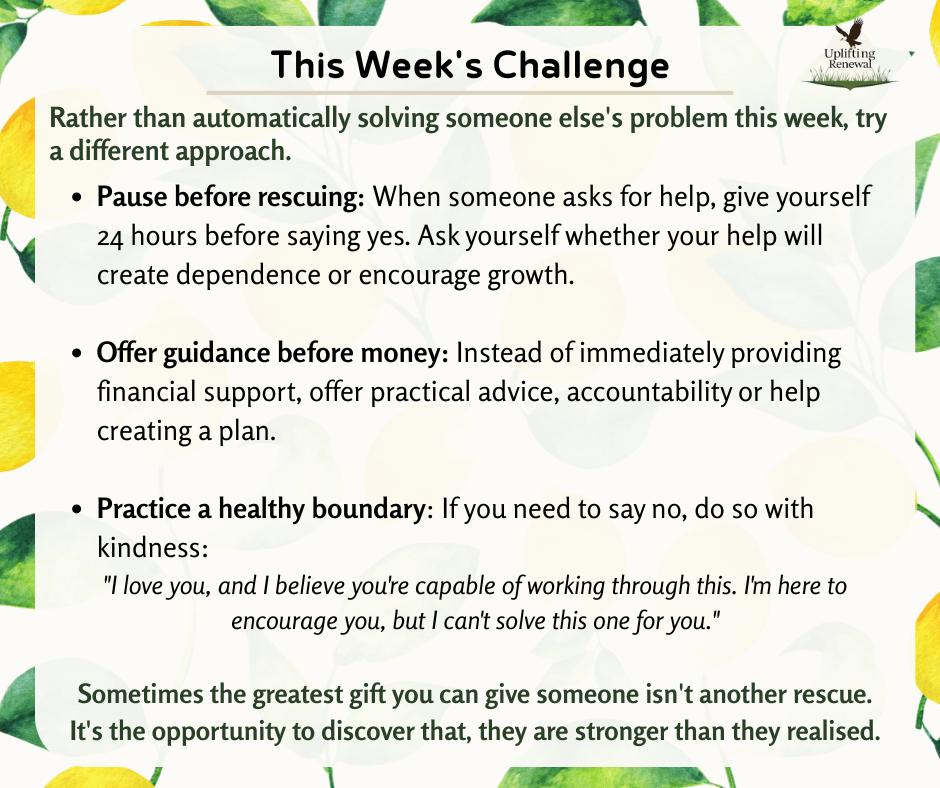
- Instead of paying another bill, help them build a budget.
- Instead of solving every crisis, help them think through possible solutions.
- Instead of giving another loan, encourage them to meet with a financial adviser or career coach.
Support should build capability, not replace it.
Ask yourself one important question before stepping in:
“Will this help them become stronger, or simply make them more dependent on me?”
That single question can change everything.
If you’re the one receiving help
Receiving support during a difficult season is nothing to be ashamed of. Life can humble any of us.
- Job losses
- Illness
- Divorce
- Bereavement
Unexpected financial hardship can leave even the most capable person needing a helping hand. We all need support at different points in life.
The key is remembering that help is designed to restore your independence, not replace it.
It is also important to remember that being helped is not an entitlement; it is a gift from a generous heart. Whether that generosity comes from a parent, sibling, child, friend, colleague, or neighbour, it should never be taken for granted.
As children, our parents have a responsibility to provide for our basic needs until we reach adulthood. Food, shelter, clothing, protection, and care are part of that responsibility. But many parents go far beyond what is required. They sacrifice to provide opportunities such as private education, family holidays, extracurricular activities, or other comforts they hope will give their children a better start in life. These are acts of love and generosity, not obligations. They could have chosen to use those resources elsewhere while still fulfilling their parental responsibilities.
The same principle applies throughout adulthood. Not everyone who has helped you did so because they had plenty to spare. Some gave from their own limited resources. Some postponed their own dreams, delayed buying a home, sacrificed family wants, worked extra hours, or gave up their time and emotional energy simply to help you through a difficult season. Often, those sacrifices remain invisible because generous people rarely announce what they have given up.
For that reason, never assume that someone who helped you yesterday is able or obligated to help you today.
- Circumstances change
- Financial pressures arise
- Health declines
- Priorities shift.
They may now be caring for children, ageing parents, or facing struggles they have chosen to keep private. Just because you cannot see their burdens doesn’t mean they don’t exist.
If someone says “no” to your request, resist the temptation to respond with anger, guilt, or resentment. Their decision is theirs to make. Respecting that decision is a sign of emotional maturity and gratitude for the support they have already given.
Don’t allow a sense of entitlement to someone else’s resources to create a rift in your relationships!
If you’ve relied heavily on family for a long time, rebuilding trust often begins with small but meaningful steps.
- Take ownership of your finances
- Create a realistic plan
- Seek advice where needed
- Demonstrate through your actions that you are working toward greater independence.
Most importantly, don’t allow the relationship to revolve around your needs.
- Call simply to ask how they are doing
- Celebrate their successes
- Offer encouragement
- Be present during their difficult seasons as well.
Healthy families and healthy relationships are never one-sided. While there are seasons when one person gives more than another, over the course of a lifetime love, care, encouragement, and support should flow in both directions. That mutual generosity is what strengthens relationships and allows them to flourish for years to come.
If you’re the one constantly giving
Boundaries often feel uncomfortable because compassionate people confuse them with rejection.
They aren’t the same thing. You can love someone deeply while still saying:
- “I can’t lend money this time.”
- “I’m happy to help you think through a solution.”
- “I believe you’re capable of handling this.”
Those conversations may feel difficult. They may even upset people initially.
But boundaries protect relationships. Without them, generosity eventually becomes resentment. And resentment destroys families far faster than honest conversations ever will.
True generosity empowers
The goal is never to become less compassionate, it’s to become wiser.
Real generosity doesn’t create permanent dependence.
- It creates confidence.
- It restores dignity.
- It equips people to stand on their own feet.
When love is combined with wisdom, everyone grows.
A scriptural perspective
The Bible consistently encourages generosity, compassion and caring for those in genuine need. Yet Scripture also draws an important distinction between helping someone through hardship and enabling a lifestyle of irresponsibility.
God’s design has always balanced compassion with personal responsibility.
Paul reminds believers:
“Carry each other’s burdens…” (Galatians 6:2)
Yet only a few verses later he writes:
“Each one should carry their own load.” (Galatians 6:5)
These verses are not contradictory.
A burden is an unusually heavy weight that someone cannot carry alone.
A load is the normal responsibility each person is expected to carry.
The Bible calls us to help people with burdens, not permanently carry their everyday responsibilities.
Paul also challenged believers who had chosen idleness instead of responsibility:
“The one who is unwilling to work shall not eat.” (2 Thessalonians 3:10)
This was never about lacking compassion for those unable to work. It was about encouraging healthy responsibility for those who refused to.
Scripture also reminds us that we are stewards of the resources God has entrusted to us. Time, energy and finances are gifts to be managed wisely, not exhausted through endless rescuing.
True biblical love doesn’t simply remove consequences. It seeks long-term growth, maturity and restoration.
Sometimes that means giving generously. Sometimes it means stepping back and allowing someone to discover the strength God has already placed within them.
Wisdom knows the difference.